
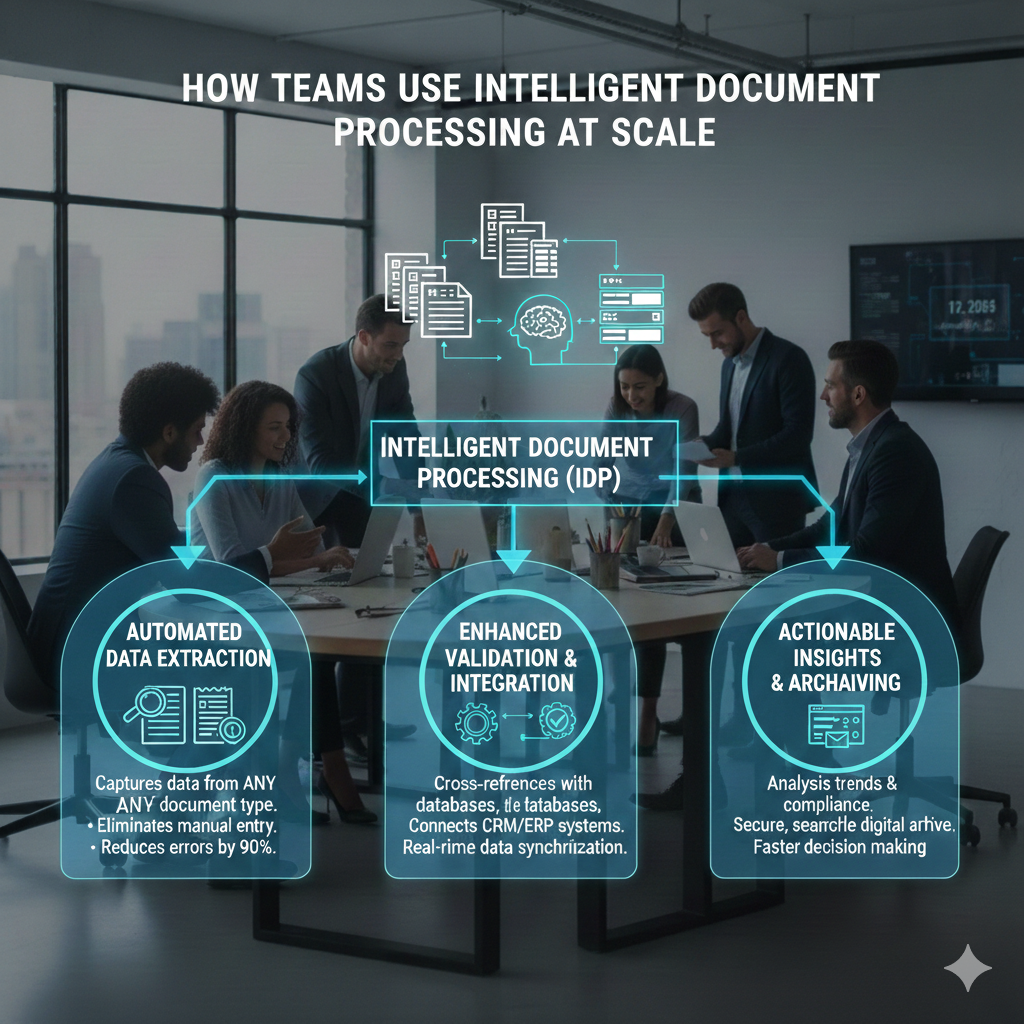
In today’s data-driven world, businesses across industries are increasingly facing the challenge of managing massive volumes of documents. Whether it’s invoices, contracts, legal documents, or customer correspondence, these documents are critical to business operations. However, managing them manually is inefficient, error-prone, and often leads to delays and compliance risks. This is where Intelligent Document Processing (IDP) comes in. By automating and optimizing the processing of documents, IDP helps teams scale their operations while improving accuracy, speed, and compliance.
Intelligent Document Processing uses a combination of artificial intelligence (AI), machine learning, and natural language processing (NLP) to understand, extract, and process data from both structured and unstructured documents. This enables businesses to scale their document handling without the need for extensive manual labor, ensuring that important information is captured and acted upon quickly.
The Challenges of Document Processing at Scale
Handling documents manually can be a massive challenge, especially as businesses grow. As document volumes increase, so do the complexities involved in managing them. Traditional methods of document processing such as scanning, manually entering data, and routing documents become inefficient and error-prone.
Here are some common challenges that teams face when managing document workflows at scale:
- Time-Consuming Tasks: Manually reviewing and categorizing documents can take up a large portion of employees’ time, reducing productivity and creating bottlenecks in business operations.
- Human Error: Manual data entry and processing are prone to errors. Misentered data or incorrect categorization can lead to costly mistakes, delays, and rework.
- Lack of Consistency: Inconsistent handling of documents often leads to confusion and inefficiencies. Different employees may interpret documents in different ways, resulting in a lack of standardization in workflows.
- Compliance Risks: Many industries have strict regulatory requirements for document management and retention. Ensuring compliance through manual processes is time-consuming and increases the risk of missing important deadlines or making errors that could lead to penalties.
How Intelligent Document Processing Addresses These Challenges
Intelligent Document Processing transforms the way teams handle documents by automating routine tasks and providing intelligent, context-aware processing. Here’s how IDP works in practice and helps businesses scale their operations:
- Automated Data Extraction
Intelligent Document Processing starts by automatically extracting data from both structured and unstructured documents. Structured documents, like forms or invoices, have predefined fields that IDP can quickly recognize. However, IDP can also process unstructured documents such as emails, contracts, and reports by analyzing the text and extracting key data points.
For instance, an invoice may contain fields such as invoice number, vendor name, and amount. IDP software uses Optical Character Recognition (OCR) to scan the document and extract that data automatically, reducing the need for manual data entry. This process can be applied to thousands of documents at scale, greatly improving speed and accuracy.
- Data Validation and Integration
After extracting the necessary data, IDP systems validate it by cross-referencing it with existing databases or systems. For example, invoice details can be validated by checking purchase orders or contracts in an enterprise resource planning (ERP) system. Any discrepancies or exceptions are flagged for review, minimizing the risk of errors.
This automated validation process significantly reduces the manual effort required for data entry and ensures that the information is accurate and reliable before it is integrated into business applications.
- Automated Document Classification and Routing
Once documents are processed and data is extracted, IDP systems automatically categorize and route the documents to the appropriate team or department. For example, an invoice might be routed to the accounts payable department, while a legal contract could be sent to the legal team for review.
This classification and routing process eliminates the need for manual intervention, ensuring that documents are handled promptly and by the right people. It also ensures that documents don’t get lost or delayed in the system, speeding up workflows and improving overall efficiency.
- Improved Search and Retrieval
IDP systems organize documents in a way that makes them easy to search and retrieve. By adding metadata, tags, and indexing data, businesses can quickly locate specific documents, even if they have large volumes of archived files. Whether it’s a contract from years ago or an invoice from last week, documents can be found in seconds using keywords, document types, or dates.
This ability to search through vast amounts of data makes IDP a valuable tool for businesses dealing with large amounts of paperwork. For example, legal teams can easily find relevant contracts or case files, while finance teams can quickly access financial statements or invoices.
- Scalability and Flexibility
Perhaps the most significant advantage of Intelligent Document Processing is its scalability. As businesses grow and the volume of documents increases, IDP systems can handle higher volumes without requiring additional manual resources. This allows organizations to scale their document processing operations seamlessly.
IDP also offers flexibility in adapting to different document types and business needs. Whether it’s invoices, contracts, or employee forms, IDP systems can be trained to process a wide range of documents, making them suitable for a variety of industries.
Real-World Applications of Intelligent Document Processing
The real power of IDP is seen in its practical applications across different industries. Here are a few examples of how teams are using IDP to scale document processing:
- Finance and Accounting: IDP has been used to automate invoice processing, eliminating the need for manual data entry and reducing the time it takes to approve and pay invoices. According to Forrester, businesses using IDP for invoice processing reduce processing time by up to 80%.
- Healthcare: In the healthcare industry, IDP is used to extract data from patient records, insurance claims, and medical bills. This not only improves data accuracy but also speeds up billing and claims processing, leading to faster reimbursements and better patient care.
- Legal: Law firms use IDP to process contracts, legal briefs, and case files. By automating the review and categorization of documents, law firms can save time, reduce errors, and ensure that critical deadlines are met.
- Customer Service: IDP systems can automatically route customer support tickets, categorize inquiries, and extract relevant details from email or chat transcripts. This allows customer service teams to respond faster and improve customer satisfaction.
- Human Resources: HR departments use IDP to automate the processing of resumes, employee forms, and compliance documents. By digitizing and organizing these records, HR teams can easily retrieve the necessary documents during recruitment, onboarding, or audits.
Conclusion
Intelligent Document Processing is transforming the way businesses handle documents, enabling them to scale their operations efficiently while reducing the risk of errors and compliance issues. By automating data extraction, document classification, validation, and routing, IDP systems help teams process documents faster, more accurately, and with greater visibility.
Whether it’s finance, healthcare, legal, customer service, or human resources, Intelligent Document Processing is a game-changing solution for teams that need to manage large volumes of documents. As businesses continue to grow, IDP will play an increasingly important role in helping organizations improve their efficiency and stay competitive in a rapidly evolving digital landscape.