
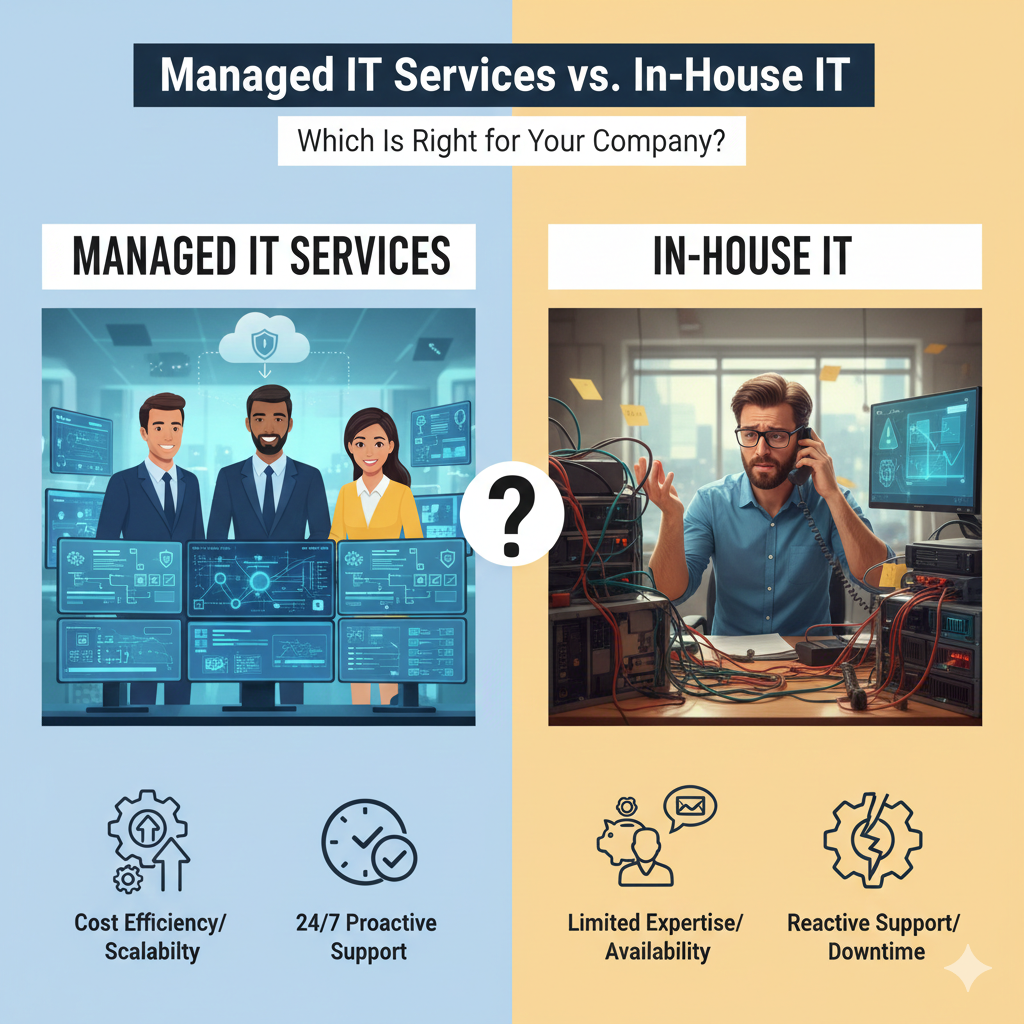
In today’s fast-paced, technology-driven business environment, companies of all sizes must ensure that their IT infrastructure is robust, secure, and efficient. Two common approaches to managing IT operations are Managed IT Services and in-house IT teams. Both have their merits, but which one is the right choice for your company? In this article, we’ll compare Managed IT Services with in-house IT to help you determine which solution best fits your business needs.
What Are Managed IT Services?
Managed IT Services involve outsourcing your IT operations to a third-party service provider. These providers take care of everything from network monitoring and security to data backup and software updates. By partnering with a managed services provider (MSP), businesses can benefit from the expertise and resources of IT professionals who manage their technology on a daily basis.
Managed IT services are typically offered on a subscription basis, which allows businesses to predict their IT costs and avoid large upfront investments in hardware or software. MSPs often offer 24/7 support, meaning businesses can access help whenever they need it. This can be a significant advantage for companies that operate in industries where uptime is critical.
In-House IT: What Does It Offer?
In-house IT refers to a company’s internal team of IT professionals who manage and maintain the business’s technology infrastructure. In-house IT teams are responsible for everything from troubleshooting technical issues and managing network security to ensuring that all systems are running smoothly.
For many businesses, having an in-house IT team allows them to have direct control over their technology and ensures that internal processes are closely aligned with company goals. In-house teams can also be more flexible and responsive to the unique needs of the business since they are part of the organization and have a better understanding of its internal operations.
Key Differences Between Managed IT Services and In-House IT
Cost Structure
One of the most significant differences between Managed IT Services and in-house IT is the cost structure. Managed IT services generally involve a fixed monthly or annual fee, which covers all aspects of IT management, from routine maintenance to emergency support. This predictable pricing model allows businesses to budget their IT expenses more effectively.
In contrast, in-house IT teams require significant upfront investment. Companies must hire IT staff, pay salaries, provide benefits, and purchase the necessary hardware and software. Over time, these costs can add up, especially if the IT team requires specialized skills or certifications. Additionally, in-house teams may also incur hidden costs, such as training expenses or the need for temporary staff during peak times.
Expertise and Specialization
Managed IT Services providers offer access to a team of experts who specialize in various aspects of IT, from cybersecurity and cloud solutions to data management and software deployment. MSPs often have a broad range of knowledge and experience in different industries, meaning they can provide tailored solutions that are best suited for a company’s needs.
On the other hand, in-house IT teams typically have specialized skills within specific areas. While these teams are familiar with the company’s internal processes and operations, they may lack the wide-ranging expertise that an MSP can offer. Moreover, with in-house IT, businesses are dependent on the skillset of their current employees and may need to invest in ongoing training to keep up with the latest technology trends.
Scalability and Flexibility
As businesses grow, their IT needs often become more complex. One of the significant advantages of Managed IT Services is scalability. MSPs can quickly scale their services to match the needs of a growing business, whether that means increasing storage capacity, adding new devices to the network, or expanding cybersecurity measures.
In-house IT teams may struggle with scalability, particularly if a company lacks the resources to hire additional staff or purchase the necessary hardware. Scaling up an internal IT department can be time-consuming and costly, especially if the business is experiencing rapid growth or technological changes.
24/7 Support and Uptime
For many businesses, minimizing downtime is critical. Managed IT Services often include 24/7 support, meaning that any IT issues are resolved quickly, even outside of regular business hours. This level of support ensures that businesses can operate around the clock without worrying about technology disruptions.
In-house IT teams may not have the same level of availability. While they may offer support during business hours, emergencies that arise after hours or on weekends may require employees to wait until the next working day. Depending on the business, this downtime could result in lost productivity or revenue.
Focus on Core Business Functions
When companies handle IT internally, it often takes away focus from their core business functions. In-house IT teams may spend considerable time on routine maintenance, troubleshooting, and system updates, which can divert attention from critical business goals.
By opting for Managed IT Services, businesses can free up internal resources and allow their teams to focus on driving growth and innovation. Since MSPs handle much of the technical work, employees can concentrate on their core responsibilities without being bogged down by technology-related challenges.
Which Is Right for Your Company?
The decision between Managed IT Services and in-house IT largely depends on your company’s size, industry, and technology needs. Here are a few factors to consider when making the decision:
- Small to Medium-Sized Businesses (SMBs): SMBs often find Managed IT Services to be the most cost-effective solution, as it provides access to a team of experts at a predictable price. Outsourcing IT allows these businesses to scale efficiently without the need for large internal teams.
- Large Enterprises: Larger organizations with complex IT infrastructure and a dedicated budget for IT management may prefer in-house IT teams. Having internal staff allows for more direct control over systems and processes. However, many large companies still choose to supplement in-house teams with managed services for specialized expertise or additional support.
- Companies with Rapid Growth: For businesses that are scaling quickly, Managed IT Services offer flexibility and scalability that in-house teams may struggle to provide. MSPs can quickly adapt to the needs of growing businesses, ensuring that IT systems are always aligned with organizational goals.
Conclusion
Both Managed IT Services and in-house IT teams offer unique advantages, and the right choice for your company depends on your specific needs, budget, and growth trajectory. If you’re looking for cost-efficiency, scalability, and specialized expertise, Managed IT Services might be the ideal solution. However, if your business requires direct control over IT operations or has specific industry needs that require tailored support, an in-house IT team might be a better fit.
Ultimately, the right decision should align with your company’s goals and allow you to maximize your IT investments. Whether you choose Managed IT Services or in-house IT, investing in reliable IT support is essential for ensuring your business operates smoothly and remains competitive in the digital age.