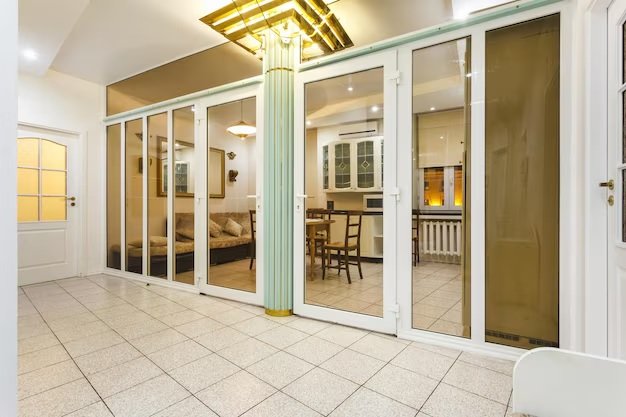
Walk into any modern interior today and you’ll notice something interesting – the most refined spaces no longer rely on conventional timber panels. Designers and architects are shifting toward advanced engineered surfaces because they solve problems that wood has struggled with for decades.
Without a doubt, choosing the right material is no longer just about appearance; it determines durability, hygiene, maintenance and long-term performance. Through this article, we will take a look at why a WPC PVC board or panel is steadily becoming the preferred alternative to traditional panel materials.
1. Dimensional Stability That Outperforms Wood
Traditional wooden boards react visibly to climate changes, especially in regions with fluctuating humidity as well as temperature. WPC and PVC boards, on the other hand, are manufactured under controlled conditions; this gives them structural consistency that wood cannot guarantee. WPC and PVC boards offer –
- Minimal expansion/contraction across seasons
- Warp-resistant composition
- Uniform density throughout the sheet
- Reliable performance in both dry & humid interiors
This stability ensures that furniture panels, partitions as well as wall cladding maintain their alignment, finish along with inherent strength for decades on end.
2. Design Possibilities without Compromise
Natural wood has limitations for designing as too much customisation compromises its integrity. WPC and PVC boards are a better alternative that provide the following benefits –
- Thermoforming capability for curvy or pattern designs
- CNC cutting capability for intricate designs with clean edges
- Smooth surface for high-grade printing & painting
- High customization possibilities
This makes a WPC/PVC board the most popular choice for use in modular furniture, decorative panels, signs, partitions or other design-centric projects.
3. Built for Moisture-Prone Areas
Wood expands, twists or rots when exposed to high humidity. This does not happen with high quality WPC and PVC boards as they are –
- 100% water & moisture proof
- Able to retain shape in various areas
A WPC/PVC board used in cabinetry or vanities will retain its shape even in the presence of constant steam or moisture. This makes it far more reliable than plywood or timber.
4. Hygiene Benefits
Natural boards can collect fungi, bacteria or insects. On the other hand, high quality WPC and PVC boards are –
- Anti-fungal & anti-bacterial in nature
- Termite & borer resistant
- Non-porous surface
- Good for a stain-free interior
This makes a WPC panel board ideal for use in hospitals, kitchens or even workspaces.
5. Easy to Work With
Builders want boards that are easy to work with yet structurally sound. WPC and PVC boards are –
- Lightweight for easy handling and shaping
- More secure with a high screw-holding capacity
A WPC panel board can be cut, drilled or machined just like traditional wood, making it really easy to work with.
The Koemmerling Advantage
Koemmerling has established itself as a benchmark name in high-performance interior solutions. Its KömaBoard WPC and PVC boards or sheets are engineered with German precision to deliver durability, pristine white surface finish and consistent structural strength that can last for decades on end without requiring a lot of maintenance.
Architects and builders favour these boards because they align with contemporary design trends — minimalist surfaces, precise detailing and adaptable forms — while also supporting sustainable construction goals. Their stable composition ensures accurate machining, smooth finishes as well as reliable long-term performance across residential, commercial along with institutional projects.
Conclusion
While traditional materials like wood have been used for a very long time in construction as well as renovation projects, the requirements of modern construction cannot be met by materials like these. Modern construction requires materials to be resistant to moisture, adhere to high standards of hygiene, be conducive to complex designs and be environmentally friendly, all at the same time.
Modern materials such as PVC and WPC, therefore, surpass wood, their predecessors, in every aspect. Whether it’s the need for modern interior designs, the demand for high-quality interior materials or the need for high-performance materials like those offered by KömaBoard, the modern alternative is way better than the traditional one.