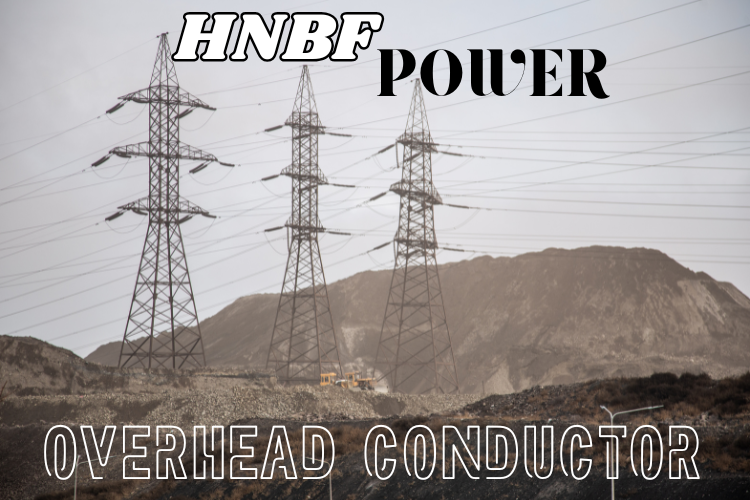
In today’s rapidly expanding transmission and distribution networks, the overhead conductor remains one of the most critical components for ensuring safe, efficient, and long-term power delivery. Utilities, EPC contractors, and grid developers face increasing challenges higher load demands, longer spans, harsher environments, and tighter project timelines.
As a global manufacturer of overhead conductors and power cables, HNBF Power delivers engineered conductor solutions designed to meet the real operational needs of modern power networks. From rural distribution lines to high-capacity transmission corridors, selecting the right overhead conductor directly impacts line losses, mechanical reliability, and total lifecycle cost.
This guide explains how overhead conductors work, how to select the right type for your project, and how professional manufacturers support utilities with customized solutions.
What Is an Overhead Conductor?
An overhead conductor is a bare or insulated electrical conductor installed on poles or towers to transmit and distribute electrical energy through open air. Unlike underground cables, overhead conductors rely on optimized mechanical design and surface exposure to maintain thermal performance, sag control, and long-term durability.
Typical applications include:
- High-voltage and medium-voltage transmission lines
- Urban and rural distribution networks
- Industrial and renewable power projects
- Substation outgoing feeders
The main technical objectives of any overhead conductor are to carry current efficiently, maintain mechanical stability under wind and ice loading, and resist environmental degradation over decades of service.
Main Types of Overhead Conductors Used in Power Networks
AAC – All Aluminum Conductor
AAC conductors are widely used in short-span and urban distribution networks where corrosion resistance and lower structural loading are important. Their all-aluminum construction offers excellent conductivity with relatively low weight.
AAAC – All Aluminum Alloy Conductor
AAAC conductors provide higher mechanical strength than AAC while maintaining good electrical performance. They are commonly selected for coastal and high-corrosion regions due to their superior resistance to atmospheric degradation.
ACSR – Aluminum Conductor Steel Reinforced
ACSR remains one of the most widely deployed overhead conductor types worldwide. The steel core significantly increases tensile strength, allowing for longer spans and higher mechanical loading capacity in transmission lines.
ABC – Aerial Bundled Cable
For low-voltage distribution, ABC systems combine multiple insulated conductors into a bundled configuration. They improve public safety, reduce right-of-way requirements, and minimize power theft in dense urban areas.
Key Performance Parameters for Overhead Conductor Selection
Electrical Capacity and Thermal Rating
Engineers must evaluate continuous current rating, emergency overload capability, and conductor surface temperature limits. A well-designed overhead conductor reduces losses while maintaining safe operating margins.
Mechanical Strength and Sag Control
Conductor tension, creep behavior, and sag under high temperatures are crucial for maintaining statutory ground clearance and mechanical safety.
Environmental Resistance
Overhead conductors must withstand:
- UV radiation and high solar exposure
- Industrial pollution and salt fog
- Wind vibration and galloping
- Ice and snow accumulation
Compatibility With International Standards
Professional utilities typically specify compliance with internationally recognized technical standards issued by organizations such as the International Electrotechnical Commission, ASTM International, and the Institute of Electrical and Electronics Engineers.
Engineering and Manufacturing Capabilities at HNBF Power
HNBF Power focuses on manufacturing overhead conductor systems tailored for utility-scale deployment and EPC projects. The company produces a full range of AAC, AAAC, ACSR, ABC, and low-voltage power cables for transmission and distribution infrastructure.
Advanced Conductor Design
HNBF Power’s engineering team supports utilities with:
- Conductor selection based on ampacity and route profile
- Mechanical modeling for long-span and high-load conditions
- Corrosion-resistant material options for coastal and industrial regions
- Optimized strand construction for reduced vibration and fatigue
Quality-Driven Manufacturing
Every overhead conductor is produced under controlled production processes, including wire drawing, stranding, compaction, and surface inspection. Electrical resistance, tensile strength, elongation, and dimensional stability are verified to ensure consistency throughout large-volume utility orders.
Project-Oriented Supply for EPC Contractors
For grid expansion and rehabilitation projects, HNBF Power supports:
- Custom drum lengths and packaging
- Fast production scheduling
- Batch traceability and test documentation
- Technical drawings and datasheets for engineering approval
This project-focused approach allows procurement teams to reduce logistical risks while maintaining compliance with project specifications.
Why Utilities and Grid Developers Choose Professional Overhead Conductor Manufacturers
A professionally engineered overhead conductor solution delivers measurable operational benefits:
- Lower line losses through optimized conductor cross-section
- Improved mechanical reliability in high-wind and high-temperature regions
- Longer service life and reduced maintenance cycles
- Faster line installation and commissioning
When utilities evaluate total ownership cost, conductor quality and manufacturing consistency play a decisive role in long-term grid performance.
FAQs About Overhead Conductors
1. How do I choose between AAC, AAAC, and ACSR overhead conductors?
The selection depends on span length, mechanical loading, corrosion environment, and required ampacity. AAC is preferred for short spans, AAAC for corrosive environments, and ACSR for long-span or high-strength transmission lines.
2. Are overhead conductors suitable for harsh climates?
Yes. With proper material selection and strand design, overhead conductors can operate reliably in coastal, desert, mountainous, and cold-weather environments.
3. What technical data should procurement teams request from manufacturers?
Key documents include type test reports, routine test results, tensile strength data, electrical resistance values, and compliance certificates to relevant international standards.
4. Can overhead conductors be customized for specific grid projects?
Professional manufacturers can adjust conductor construction, strand configuration, drum lengths, and packaging to match project-specific requirements.
Power Your Network With Reliable Overhead Conductor Solutions
Choosing the right overhead conductor is essential for building safe, efficient, and future-ready power networks. With extensive manufacturing capability and engineering support, HNBF Power delivers dependable conductor solutions for transmission and distribution projects worldwide.
Contact HNBF Power today to discuss your overhead conductor requirements and receive customized solutions designed for your grid performance, installation conditions, and long-term operational goals.