
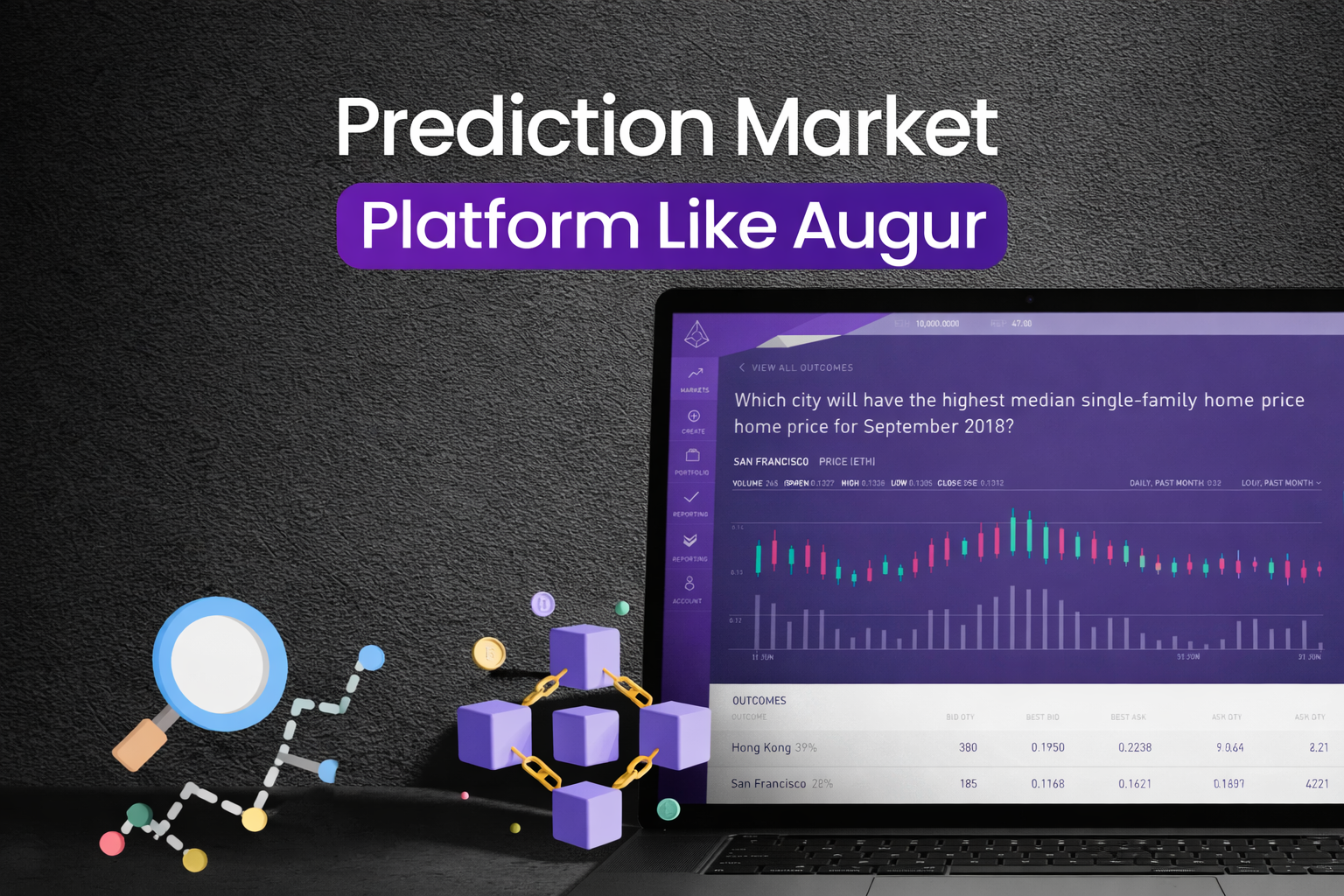
Prediction markets have become one of the most fascinating applications of blockchain technology. Instead of relying on polls or expert opinions, these platforms allow people to trade on the probability of future events, turning collective intelligence into market-driven forecasts.
Decentralized prediction markets have gained particular attention over the last few years, largely due to platforms like Augur. Built on blockchain technology, Augur allows users to create markets, trade on outcomes, and earn rewards without relying on centralized authorities.
For startups and entrepreneurs, this has opened an entirely new opportunity: launching their own decentralized prediction markets. However, building a platform like Augur involves much more than deploying smart contracts. It requires strong architecture, secure infrastructure, regulatory awareness, and a carefully designed user experience.
In this guide, we’ll break down everything founders need to know about building a prediction market platform like Augur—including its core features, development cost, and technology stack.
What Is a Prediction Market Platform?
A prediction market platform is a digital marketplace where users trade contracts based on the likelihood of future events. The price of each contract reflects the crowd’s estimate of the probability that the event will occur.
For example, a market might ask:
“Will Bitcoin cross $100,000 this year?”
If shares for “Yes” are trading at $0.70, the market believes there is a 70% chance that the event will happen.
Prediction markets can cover many categories, including:
- Politics and elections
- Sports outcomes
- Financial markets
- Cryptocurrency trends
- Technology breakthroughs
- Global events
Blockchain-based platforms like Augur and Polymarket have demonstrated how decentralized infrastructure can improve transparency, security, and accessibility.
This growing demand is pushing many startups to invest in prediction market platform development as a new Web3 business model.
Why Startups Are Building Augur-Like Platforms
The idea of decentralized prediction markets appeals to many entrepreneurs because of their potential to combine finance, data intelligence, and blockchain technology.
Several factors are driving interest in crypto prediction market platform development.
First, blockchain technology removes the need for centralized intermediaries. Transactions are recorded on a distributed ledger, making them transparent and tamper-resistant.
Second, smart contracts automate market settlement. Once the outcome of an event is verified, payments are executed automatically.
Third, prediction markets can generate revenue through trading fees, liquidity pools, and token economies.
Finally, the collective intelligence generated by these platforms has real-world value. Businesses, researchers, and policymakers can use prediction market data to make more informed decisions.
For startups looking to build prediction market platform solutions, these advantages create a compelling opportunity.
Key Features of a Prediction Market Platform Like Augur
Building a successful prediction market requires much more than basic trading functionality. The platform must combine blockchain infrastructure, financial market mechanics, and a user-friendly interface.
Below are the most important features founders should include.
Market Creation
Users should be able to create new prediction markets around specific events.
This includes defining:
- Event description
- Possible outcomes
- Market closing time
- Resolution mechanism
A flexible market creation system allows the platform to support diverse prediction categories.
Trading Engine
At the heart of every prediction market is a trading system where users buy and sell outcome shares.
Key components include:
- Order matching algorithms
- Liquidity pools
- Market pricing mechanisms
- Transaction validation
A reliable trading engine ensures smooth market operations and accurate pricing.
Smart Contracts
Smart contracts handle most of the platform’s logic, including:
- Market creation
- Trade execution
- Fund escrow
- Outcome settlement
Blockchain-based contracts remove the need for manual oversight and ensure transparency.
Oracle Integration
Prediction markets rely on external data sources to determine event outcomes.
Oracles act as bridges between blockchain networks and real-world data. They verify whether an event actually occurred.
Without reliable oracle systems, prediction markets cannot function properly.
Token Economy
Many decentralized prediction markets use native tokens for governance, rewards, and staking.
Tokens may be used for:
- Trading fees
- Liquidity incentives
- Dispute resolution
- Platform governance
Tokenomics design is crucial for long-term platform sustainability.
Dispute Resolution System
Sometimes, market outcomes may be contested. A dispute resolution mechanism ensures fairness.
This can involve:
- Token-based voting
- Community juries
- Escrow staking
Platforms like Augur use decentralized governance to resolve disputes.
Wallet Integration
Crypto prediction markets must support secure wallet connectivity.
Common integrations include:
- MetaMask
- WalletConnect
- Coinbase Wallet
These wallets allow users to manage funds and interact with smart contracts directly.
User Dashboard
Even though prediction markets are technically complex, the user interface must remain simple.
A well-designed dashboard should display:
- Active markets
- Trading history
- Portfolio performance
- Market trends
User experience plays a huge role in adoption.
Tech Stack for Building a Prediction Market Platform
Choosing the right technology stack is essential for scalability, security, and performance.
Below is a typical tech stack used in prediction market platform development.
Blockchain Layer
Popular blockchain networks include:
- Ethereum
- Polygon
- Binance Smart Chain
- Solana
Ethereum remains the most widely used network due to its strong developer ecosystem.
Smart Contract Development
Smart contracts are typically written using:
- Solidity
- Vyper
These languages allow developers to program decentralized applications and automated financial systems.
Frontend Development
User interfaces are often built using modern frameworks such as:
- React.js
- Next.js
- Vue.js
These frameworks help create responsive, real-time dashboards.
Backend Infrastructure
While blockchain handles core transactions, traditional servers still manage:
- APIs
- user authentication
- market indexing
- analytics
Common backend technologies include Node.js, Python, and Go.
Database Systems
Prediction market platforms often use hybrid databases:
- PostgreSQL for structured data
- Redis for caching
- IPFS for decentralized storage
Security Infrastructure
Security tools are essential to protect funds and smart contracts.
These include:
- Smart contract auditing tools
- Multi-signature wallets
- Encryption protocols
- Fraud detection systems
How Much Does It Cost to Build a Prediction Market Platform?
The cost of building a decentralized prediction market platform can vary significantly depending on complexity, features, and development location.
Below is a rough estimate.
Basic MVP Platform
Cost range: $40,000 – $70,000
Includes:
- Basic trading functionality
- limited market creation
- wallet integration
- simple UI
Mid-Level Platform
Cost range: $70,000 – $150,000
Includes:
- advanced trading engine
- oracle integrations
- token economy
- analytics dashboard
Advanced Enterprise Platform
Cost range: $150,000 – $300,000+
Includes:
- scalable architecture
- AI-driven analytics
- automated compliance systems
- multi-chain support
- advanced liquidity mechanisms
For many startups, launching with a Minimum Viable Product (MVP) is the most practical strategy before scaling the platform.
Development Timeline
Building a decentralized prediction market platform usually takes 4 to 8 months, depending on complexity.
A typical development process includes:
- Product discovery and planning
- UI/UX design
- Smart contract development
- Backend infrastructure setup
- Wallet and blockchain integration
- Security audits
- Testing and deployment
Working with experienced blockchain developers can significantly reduce development risks.
The Role of AI in Prediction Market Platforms
Artificial intelligence is starting to play a major role in improving prediction market functionality.
AI systems can analyze trading patterns, detect suspicious activity, and generate predictive insights.
Advanced platforms may include:
- market trend analysis
- anomaly detection
- automated liquidity optimization
- predictive analytics dashboards
This is where collaboration with an experienced AI development company becomes valuable. AI-driven tools can enhance user experience and improve the accuracy of market forecasts.
Choosing the Right Development Partner
Building a decentralized prediction market is a complex project involving blockchain architecture, financial systems, and advanced security protocols.
Many startups choose to work with specialized development partners to accelerate the process.
Companies like Suffescom Solutions provide end-to-end support for Web3 platforms, including blockchain development, smart contract engineering, and scalable fintech infrastructure. Partnering with experienced developers helps founders launch secure, compliant, and scalable platforms while focusing on business growth.
Future Trends in Prediction Market Platforms
The prediction market industry is still evolving, and several trends are shaping its future.
First, multi-chain interoperability will allow users to trade across different blockchain networks.
Second, AI-powered forecasting tools will enhance market insights and data analysis.
Third, regulatory frameworks are gradually becoming clearer, which may open the door for mainstream adoption.
Finally, integration with decentralized finance (DeFi) ecosystems will unlock new liquidity opportunities for prediction markets.
For startups willing to innovate, the next decade could bring massive growth in this space.
Conclusion
Prediction markets represent a powerful combination of blockchain technology, financial incentives, and collective intelligence. Platforms like Augur have proven that decentralized systems can create transparent, community-driven forecasting tools.
However, launching a successful prediction market requires careful planning, robust infrastructure, and a secure technology stack.
From smart contracts and oracle integrations to user-friendly trading dashboards, every component must be designed with scalability and security in mind.
For startups exploring crypto prediction market platform development, the opportunity is significant—but so is the technical complexity. By partnering with experienced developers, focusing on strong product design, and adopting emerging technologies like AI, founders can successfully build prediction market platform solutions that stand out in the growing Web3 ecosystem.
FAQs
1. What is a prediction market platform?
A prediction market platform is an online marketplace where users trade contracts based on the probability of future events.
2. How long does it take to build prediction market platform solutions?
Developing a prediction market platform typically takes between 4 and 8 months, depending on features and complexity.
3. What technologies are used in crypto prediction market platform development?
These platforms usually use blockchain networks, smart contracts, decentralized storage, and modern web frameworks for frontend and backend systems.
4. How much does it cost to build a prediction market platform?
The cost generally ranges from $40,000 to $300,000+, depending on platform complexity and development scope.
5. Why do prediction markets use blockchain technology?
Blockchain ensures transparency, decentralization, and automated settlement through smart contracts, making prediction markets more secure and trustworthy.
