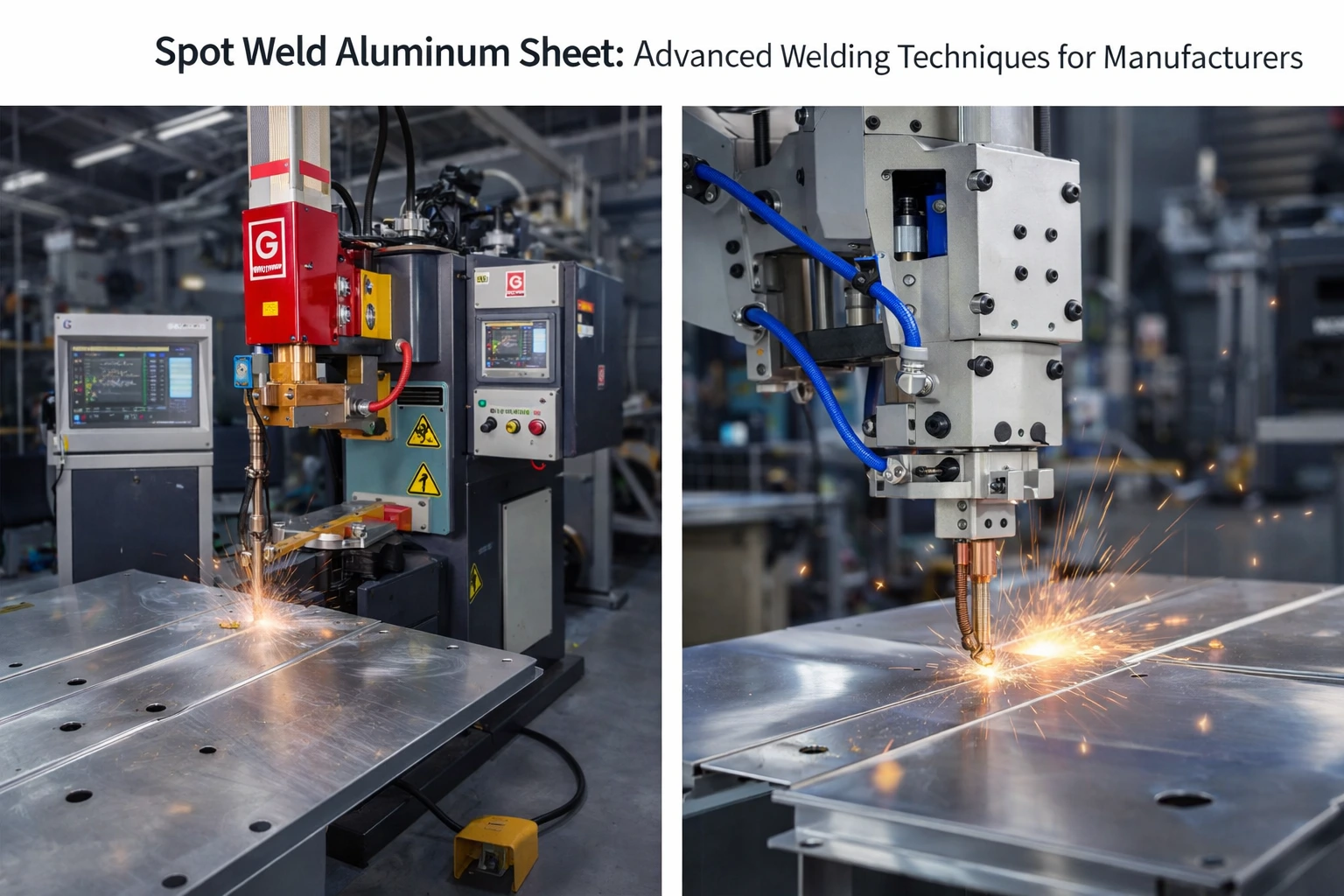
In today’s fast-paced manufacturing environment, efficiency, precision, and repeatability are non-negotiable. For industries relying on metal-joining processes, a spot resistance welder is an indispensable tool that combines speed and reliability with minimal operator intervention. Whether you’re an OEM, automation integrator, or plant decision-maker, understanding how spot resistance welding works and selecting the right solution can transform your production line.
At Heron Welder, we specialize in high-performance welding solutions, from resistance welding machines to fully automated production lines, designed to meet the exacting demands of modern industry.
What Is a Spot Resistance Welder?
A spot resistance welder is a type of resistance welding machine that joins two or more metal sheets at discrete points by applying heat generated from electrical resistance. Unlike other welding methods that require filler material or shielding gas, spot welding uses only the workpieces’ own resistance to the current flow to form a strong, localized weld.
Key components of a spot resistance welder include:
- Electrodes – Copper alloy tips that conduct current and apply pressure to the workpieces.
- Transformer/Power Source – Supplies the high current needed for welding. Modern machines may use MFDC (Medium-Frequency Direct Current) technology for enhanced control.
- Control System – Regulates current, weld time, and electrode force for consistent quality.
The process is simple yet precise: the metal sheets are clamped between electrodes, a high current passes through the contact area, the resistance generates heat, and a weld nugget forms as the metals fuse together.
How Spot Resistance Welding Works
Spot resistance welding is a controlled thermal-mechanical process:
- Clamping: The electrodes firmly hold the metal sheets in place. Proper clamping ensures uniform pressure and minimizes electrode wear.
- Current Flow: A high electric current passes through the contact point. The resistance of the metals at that junction generates localized heat.
- Weld Formation: Heat melts the metal at the interface, forming a small nugget. The pressure from the electrodes solidifies the nugget as it cools.
- Release: The electrodes retract, leaving a strong, discrete weld.
Modern systems, like Heron’s MFDC spot welders, allow precise control over current, weld time, and force, enabling repeatable weld quality even in complex production lines.
Applications of Spot Resistance Welding
Spot resistance welding is widely used across automotive, aerospace, appliance, and electronics industries. Typical applications include:
- Automotive Body Panels: Joining steel or aluminum panels in car doors, hoods, and chassis components.
- Appliance Manufacturing: Welding sheet metal in refrigerators, washing machines, and ovens.
- Battery Assemblies: Joining thin metal sheets for battery packs and electronics enclosures.
- Structural Components: Fabricating metal frames where discrete, high-strength welds are needed.
Its speed and precision make spot welding ideal for high-volume production, especially when integrated into automated lines with robotic handling.
Advantages of Spot Resistance Welding
Choosing spot welding offers several benefits for manufacturing operations:
- Speed and Efficiency: Multiple welds can be performed per second, reducing cycle times.
- Minimal Material Distortion: Localized heating minimizes warping compared to arc welding.
- Repeatability: Programmable controls ensure consistent weld quality across thousands of parts.
- Cost-Effective: No filler metals or shielding gases are required, reducing consumable costs.
- Integration with Automation: Perfectly suited for robotic welding cells and conveyor-fed production lines.
Spot Resistance Welding vs. Other Welding Methods
Understanding the differences helps engineers select the right technique:
| Feature | Spot Resistance Welding | MIG Welding | TIG Welding | Laser Welding |
|---|---|---|---|---|
| Heat Source | Electrical resistance | Arc | Arc | Laser beam |
| Filler Material | Not required | Often required | Often required | Sometimes required |
| Speed | High | Moderate | Slow | High |
| Precision | Localized | Moderate | High | Very high |
| Automation Ready | Excellent | Moderate | Moderate | Excellent |
For high-volume metal sheet joining, spot resistance welding is often the optimal choice, balancing speed, strength, and cost-efficiency.
Best Practices for Spot Resistance Welding
To maximize performance and ensure consistent welds:
- Electrode Maintenance: Regularly dress and replace electrodes to maintain contact quality and prevent defects.
- Parameter Optimization: Adjust weld current, time, and force based on material thickness and type.
- Surface Preparation: Clean metal sheets to remove coatings or oxides that can reduce conductivity.
- Cooling and Duty Cycle: Ensure proper cooling to avoid electrode overheating and maintain cycle efficiency.
- Automation Integration: Use sensors and programmable controllers to achieve repeatable, high-quality welds in automated lines.
Heron Welder offers advanced controller technology that simplifies parameter setup, monitors weld quality, and integrates seamlessly with robotic or conveyor-based production systems.
Why Choose Heron for Spot Resistance Welding
As a global leader in industrial welding equipment, Heron Welder provides:
- Customizable Solutions: From standalone spot welders to fully automated lines.
- Diverse Technology: MFDC, capacitor discharge, and conventional resistance welding options.
- Expert Support: Engineering guidance on line integration, material handling, and process optimization.
- Global Reach: Reliable equipment and service wherever your manufacturing operations are located.
Our team helps manufacturers and OEMs reduce cycle times, improve quality, and lower operational costs with cutting-edge welding solutions.
FAQs About Spot Resistance Welding
1. Can spot welding be used on aluminum?
Yes, modern MFDC spot welders are optimized for aluminum, with precise control over current and force to handle its high thermal conductivity.
2. How thick can materials be for spot welding?
Typical thickness ranges from 0.5 mm to 6 mm for standard spot welders, with specialized machines handling even thicker sheets.
3. Is spot welding safe for high-volume production?
Absolutely. Spot welding is inherently safe and, when integrated into automated lines, reduces operator exposure to heat and sparks.
4. How do I know if my welds are consistent?
Heron’s advanced controllers monitor current, time, and electrode pressure to ensure repeatable weld quality.
5. Can spot welding be combined with other joining techniques?
Yes, it’s common to use spot welding alongside self-pierce riveting or clinching systems for hybrid metal joining.
Conclusion: Upgrade Your Production With Heron Spot Welding Solutions
A spot resistance welder is more than a machine—it’s a critical productivity tool that enhances speed, precision, and repeatability in metal joining. With proper equipment, process control, and integration, manufacturers can achieve superior results while reducing operational costs.
Heron Welder brings decades of expertise in resistance welding and automation, offering tailored solutions for every manufacturing challenge. Whether you need a single spot welder or a fully automated production line, we provide the technology and support to help your operations thrive.
Contact Heron today to request a quote or consult on a customized welding solution designed to optimize your production efficiency.