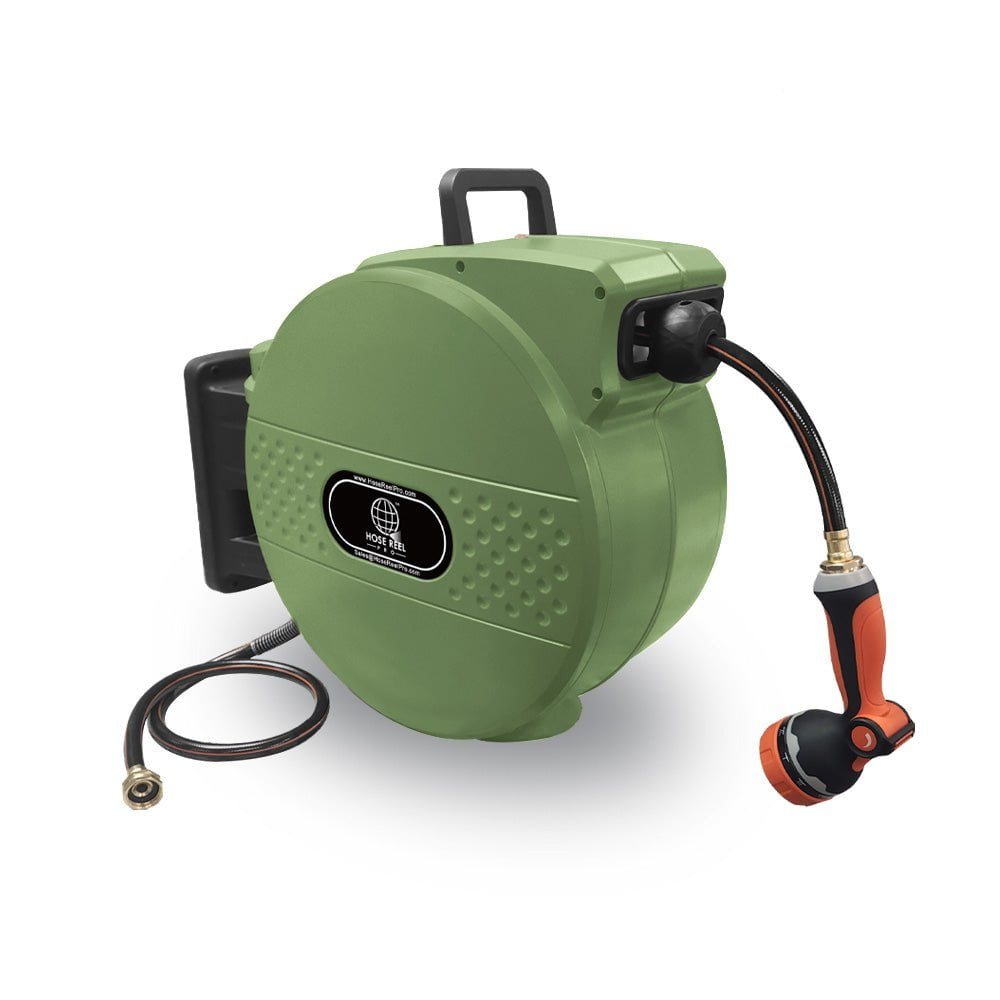
Buying a garden hose sounds simple until you stand in the aisle staring at 25-foot, 50-foot, 75-foot, and 100-foot options. Too short and you cannot reach your farthest raised bed. Too long and you drag extra weight, fight kinks, and waste storage space. Getting the length right saves frustration every time you water.
Why Hose Length Matters More Than You Think
A hose that barely reaches your garden beds forces you to stretch and strain the material. Over time, this weakens connections, causes leaks at the spigot, and leaves you standing in awkward positions while watering. You end up moving containers closer to the house or skipping beds that sit just out of range.
A hose that is far too long creates the opposite problem. Excess material piles on the ground, kinks under its own weight, and tangles during retraction. You spend more time managing the hose than actually watering. Longer hoses also weigh more, making them harder to pull across the yard and wind onto a garden hose reel.
The goal is a length that reaches your farthest watering point with 10 to 15 feet of comfortable slack, no more.
How to Measure Your Yard
- Grab a tape measure or use a measuring app on your phone.
- Start at your outdoor spigot and measure to the farthest spot you need to water, including raised beds, container gardens, hanging baskets, and any lawn areas you water by hand.
- If you have multiple watering zones, measure each one separately and use the longest measurement as your minimum hose length.
- Add 10 to 15 feet to that measurement for a buffer that lets you move around beds, reach behind plants, and water comfortably without pulling the hose taut.
- Account for vertical rise if your garden sits on a slope or deck above the spigot level.
Common Yard Layouts and Recommended Lengths
Small patios and balconies under 200 square feet usually need only a 25-foot hose. Compact spaces rarely require more, and a shorter hose stores easily on a wall-mounted water hose reel.
Urban backyards and townhouse gardens between 200 and 600 square feet do well with a 50-foot hose. You can reach raised beds along a back fence, container clusters on a patio, and a small lawn area without excess dragging behind you.
Suburban yards with multiple garden zones between 600 and 1,500 square feet typically need a 75-foot hose. This length reaches a detached vegetable garden, side yard plantings, and front flower beds from a single rear spigot.
Large properties or gardens far from the spigot may require 100 feet, but consider whether a second spigot or a freestanding reel that moves with you makes more sense. Very long hoses lose water pressure and become difficult to manage on a standard garden hose reel.
Factors That Change Your Calculation
Obstacles and pathways matter because hoses do not travel in straight lines. If yours must wind around a shed, through a gate, or along a curved path, add extra length to account for the actual route.
Spigot placement affects your needs too. Some homes have spigots on multiple sides. If you can connect closer to your main garden area, you may need a shorter hose than your initial measurement suggests.
Check your reel’s capacity before buying. Most standard reels hold 50 to 100 feet of 5/8-inch hose. A reel stuffed beyond capacity retracts poorly and wears out faster.
If you plan to add raised beds or extend your growing area next season, factor that into your measurement now. Buying a slightly longer hose today avoids replacing it in a year.
What About Connecting Two Hoses?
You can join two shorter hoses with a coupling, but every connection point introduces a potential leak and a spot where kinks form. A single hose of the correct length is almost always better than two shorter hoses linked together.
If you already own a 50-foot hose and need to reach a bed 60 feet away, adding a short extension works as a temporary fix. For permanent setups, replace the pair with a single hose that covers the full distance.
Get the Right Length From the Start
Walk your yard with a tape measure before you buy. Measure to your farthest watering point, add a 10 to 15-foot buffer, and round up to the nearest standard length. A properly sized hose winds smoothly, stores neatly, and makes every watering session easier.