
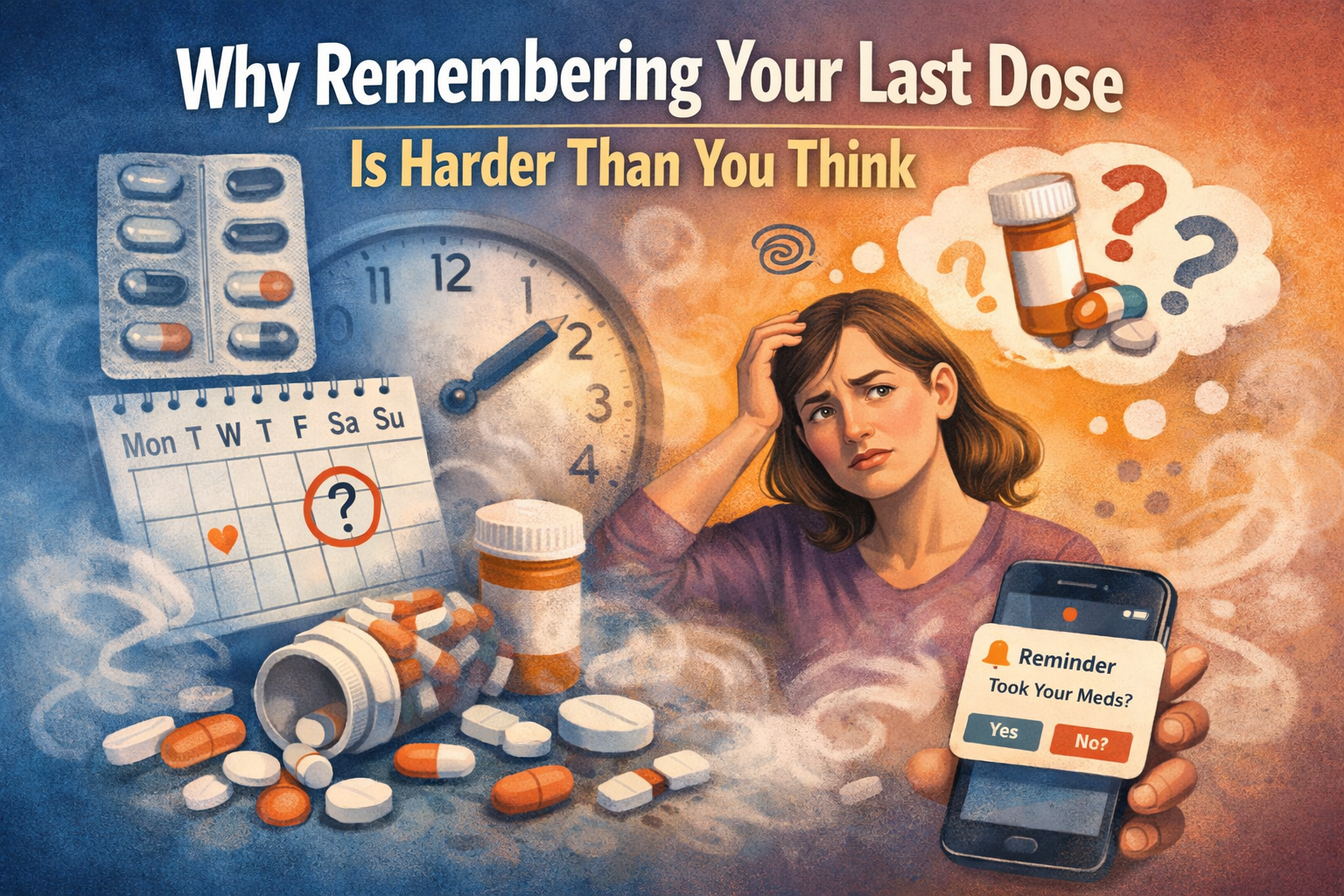
You would think something as important as taking medication would be easy to remember. After all, we remember to brush our teeth, grab our keys, and drink our morning coffee. Yet millions of people—seniors, parents, caregivers, people with chronic illnesses, even highly organized professionals—struggle with one simple question almost every day:
“Did I take my medication?”
Medication forgetfulness is far more common than most people realize. It doesn’t mean someone is careless, irresponsible, or inattentive. Instead, it reveals how human memory actually works—and why our brains simply aren’t built to track repetitive, routine tasks with perfect accuracy.
Understanding the psychology behind medication forgetfulness helps us create better systems to prevent mistakes. And in many cases, simple tools like a pharmacy cap with timer or pill bottle cap timer bridge the gap between human behavior and medication safety.
Here’s what the science tells us—and how we can apply it to real life.
Why We Forget: The Science Behind Missed or Doubled Medication Doses
Medication routines are often repetitive and unremarkable. You open a bottle, swallow a pill, and move on. The action is so quick and familiar that your brain doesn’t always store it as a memorable event.
1. Medication Becomes an Automatic Behavior
When we perform a task repeatedly, it moves from conscious thought to automatic habit. This is great for efficiency—but terrible for memory recall.
Similar to locking your front door or turning off the stove, taking medication becomes something you think you did, even when you didn’t.
2. The Brain Doesn’t Record Routine Tasks Clearly
Memory is selective. It prioritizes emotionally significant or unusual events. Taking a daily medication doesn’t trigger emotion or novelty, so the brain doesn’t store the memory strongly.
This is why so many people stare at a pill bottle thinking, I can picture taking it… but did I actually?
3. Routines Are Frequently Interrupted
You start to take your medication—and suddenly:
- Your phone rings
- A child calls you
- A coworker messages you
- The dog starts barking
- You remember something urgent
That small interruption breaks the memory formation process. You may return moments later unsure whether you completed the task.
4. Cognitive Load Overwhelms the Mind
Between work, family, emotions, and responsibilities, the brain juggles thousands of daily inputs. Medication timing becomes just one more thing competing for attention.
When cognitive load is high, working memory falters. Medication is often the first thing we forget.
5. Stress and Fatigue Reduce Recall
When you are exhausted—emotionally or physically—the brain operates in “survival mode.” Routine tasks slip through the cracks.
Seniors and caregivers, who often face high stress, are particularly vulnerable to this.
6. Multiple Medications Confuse the Mental Checklist
If you take several medications, especially on different schedules, your mental system becomes unreliable. Mixing up times and doses becomes inevitable.
These are not personal failures—they are natural outcomes of how humans are wired.
The Danger of Relying on Memory Alone
Medication forgetfulness is not just inconvenient—it can be dangerous.
Missed doses can lead to:
- Worsening symptoms
- Reduced treatment effectiveness
- Antibiotic resistance
- Blood pressure spikes
- Uncontrolled chronic conditions
Double doses can cause:
- Overdose
- Severe reactions
- Low blood pressure
- Organ damage
- Emergency room visits
When uncertainty appears—“Did I take it?”—many people either skip the dose or take it again, both of which create risks.
Why Timing Tools Help: External Memory Is More Reliable Than Mental Memory
Because the brain is naturally inconsistent with routine tasks, the safest approach is to offload medication tracking to something external, visible, and reliable.
This is where timing caps come in.
What a Pharmacy Cap with Timer Does
A pharmacy cap with timer replaces the standard prescription bottle cap and automatically records the last time the bottle was opened.
Each time you take your medication, the device updates—showing the exact hour and day of the last dose.
No apps. No settings. No remembering required.
Why a Pill Bottle Cap Timer Works Across All Ages
A pill bottle cap timer helps:
- Seniors who experience natural memory decline
- Busy adults managing stressful routines
- Caregivers overseeing multiple patients
- Parents giving medicine to kids
- Pet owners managing veterinary medications
By providing a clear, instant reminder of the last dose, timing caps protect users from guesswork and error.
The Psychology Behind Why Timing Tools Are So Effective
1. They Provide Immediate Visual Confirmation
Humans interpret visual cues quickly. A timestamp eliminates internal debate.
2. They Replace Memory with Certainty
Instead of relying on recollection, you rely on a physical record. This reduces anxiety.
3. They Support Habit Formation
Seeing the time encourages consistent daily routines and strengthens the medication habit loop.
4. They Reduce Decision Fatigue
You no longer need to think, check, or second-guess. The decision is made for you.
5. They Improve Safety Without Adding Complexity
Unlike apps, timing caps work instantly and require no learning curve.
Medication Forgetfulness Is Human—But It’s Also Preventable
Once you understand why remembering your last dose is so difficult, it becomes clear that memory alone is not a reliable strategy. And that’s perfectly normal.
By using simple, accessible tools like a pharmacy cap with timer, families can prevent medication errors and reduce stress. These tools don’t replace your routines—they strengthen them. They don’t demand attention—they support your attention. And most importantly, they bring clarity in moments of uncertainty.
A small device can make an enormous difference. It transforms forgetfulness into confidence, confusion into safety, and routine into reliability.
Because no one should have to guess when the last dose was taken—your health deserves more certainty than that.